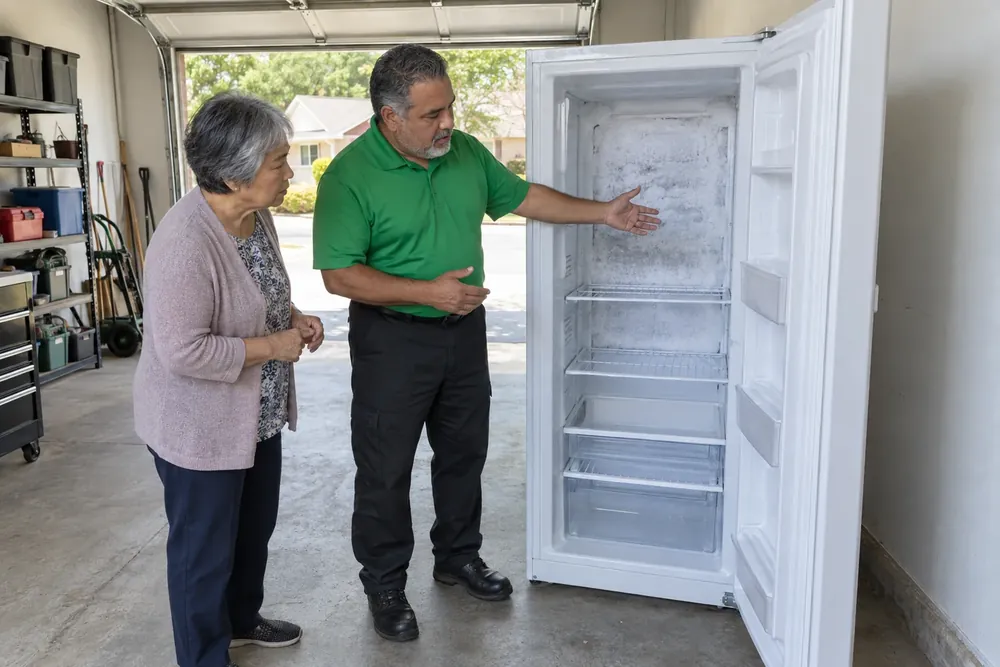
From Your Call Through the Repair
Call and say which appliance is failing and what it is doing; one of our local appliance repair partners takes it from there. A refrigerator that feels warm, a washer holding water or an oven that will not heat gives the conversation a clear starting point. You can describe the problem without identifying which part has failed.
Start With the Problem You Notice
The appliance, symptom and town are enough to start your request. Explain what changed, such as a new noise, a stopped cycle or a puddle under the door. Say whether a cooking appliance or dryer uses gas or electricity if you already know. Describe what happened without trying another cycle to reproduce a troubling symptom.
If you have the brand and model label handy, those details help identify the appliance. Reading a label is optional, and there is no need to move a heavy machine to find one. If a display shows an error code, read the exact letters and numbers during the call. Codes vary across brands and models.
Your Technician Checks the Cause
Your technician examines the appliance and checks the reported fault to work out what needs attention. Similar symptoms can come from different causes, so a noise or error code alone does not settle the diagnosis. Share whether the problem happens every cycle or only occasionally.
Your technician explains the findings, the proposed repair and the price before work begins. Parts, access to the appliance and the work involved affect the repair decision. Ask what the proposed work includes and how the diagnosis relates to the symptom you reported. You decide whether to proceed with that repair.
Parts Determine the Repair Steps
The repair follows your approval and depends on the parts needed for your model. Your technician replaces or repairs the affected components as appropriate, then checks the appliance's operation. Testing focuses on the original fault, such as whether the washer drains or the oven heats as intended.
A part that needs ordering means a return visit to complete the work. Your technician explains which part is needed and discusses the next steps with you. The model matters because parts that look alike are not necessarily interchangeable. Learn more about the decision factors on the repair or replace page.
Keep Safety Simple While Waiting
Switch a malfunctioning appliance off at its controls, or unplug it only when the plug is easy and safe to reach. Avoid further use when the appliance leaks, overheats or behaves unpredictably. Keep the doors of a warming refrigerator or freezer shut as much as practical; repeated opening lets more cold air escape.
If you smell gas, do not touch switches; leave and call the gas utility or 911 from outside. Call about the appliance repair after taking those safety steps. You do not need to investigate the source yourself. For a problem without an immediate hazard, call now and describe what you noticed.